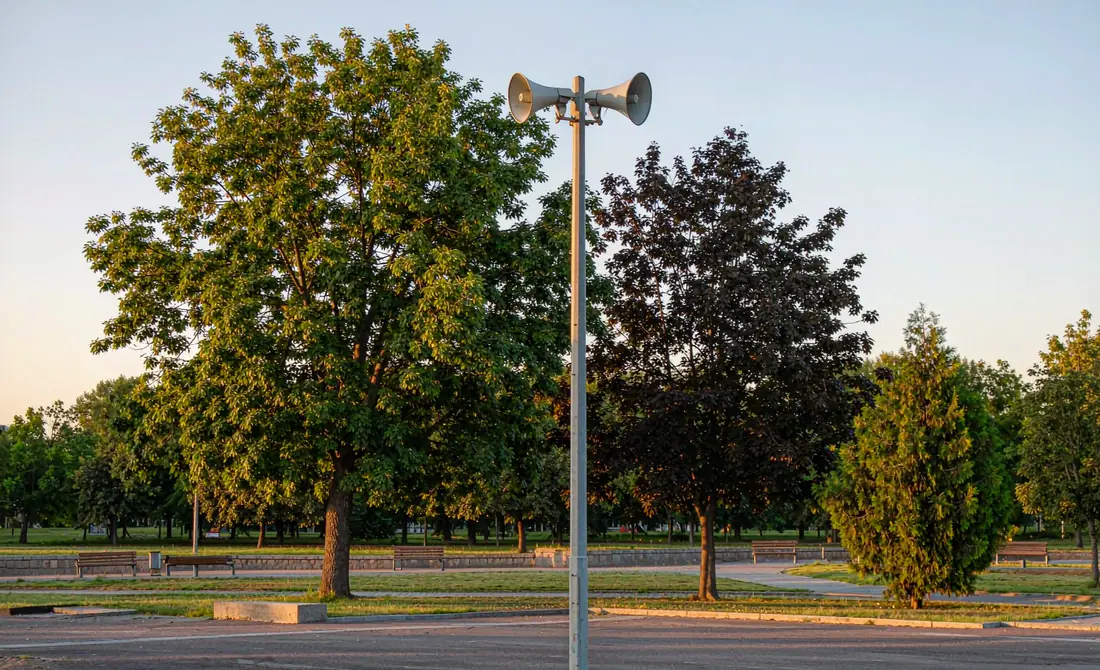
No walls, no ceiling, and a listener 150 metres away. Outdoor design is arithmetic: distance, level, pole position — then weather protection that survives the third summer.
Outdoors there are no walls to help you. Sound leaves the horn, spreads, is absorbed by air and foliage, and competes with traffic, wind and distance. Outdoor design is therefore mostly arithmetic: how far, how loud, how many horns, and where the pole goes.
The inverse-square law does not negotiate. Every doubling of distance costs 6 dB, and air absorption takes another 1–2 dB per 100 m at speech frequencies. A horn rated 133 dB at 1 m gives approximately the following in still air:
| Distance | Level (still air) | Condition |
|---|---|---|
| 10 m | ≈ 119 dB | Too loud for a listener standing under the pole |
| 50 m | ≈ 105 dB | Full intelligibility, comfortable |
| 100 m | ≈ 99 dB | Clear speech, still dominant over traffic |
| 200 m | ≈ 93 dB | Audible and mostly intelligible; wind becomes the limiting factor |
| 400 m | ≈ 87 dB | Music audible, speech marginal — add a second pole instead |
The practical rule for a plaza or park: one horn cluster per 150–200 m of coverage, mounted 6–10 m up, and never rely on a single pole turned up to reach the far end.
| Failure | Cause | Specification answer |
|---|---|---|
| Water in the driver | Driving rain at an upward-facing horn mouth | IP66 housing, mouth angled down, drain path at the lowest point |
| UV degradation | Two to three summers of direct sun on the grille and cable jacket | UV-stabilised ABS or coated aluminium; cable in UV-rated conduit, not exposed |
| Lightning surge | Induced surge on a long outdoor line | Surge arrestor at the pole base and at the rack; earth the pole independently of the audio screen |
Temperature range matters too. Sites in the Gulf need equipment rated for 55 °C ambient in direct sun, and sites in northern China need −25 °C cold start. A horn that works in a Guangzhou showroom is not automatically a horn that survives both.
Most public-space systems end up doing both, and the design must keep them separable:
| Function | Recommended | Notes |
|---|---|---|
| Pole-mounted coverage | EQ series horn speakers or ES-60SO 60 W SIP horn, 133 dB | Two horns per pole at 60–90 degrees apart beats one horn at double power |
| Walkway and colonnade | EYZ outdoor column series | Narrow vertical pattern keeps sound on the path and off the buildings |
| Network-powered sites | SIP network audio with PoE | Only where fibre or copper reaches the pole; otherwise use a 100 V line |
| Amplification and zoning | EG series amplifiers with zone editors | 100 V line is still the right answer for long outdoor runs |
A 60 W horn rated 133 dB at 1 m stays clearly intelligible to roughly 150–200 m in still air, and to about 100 m once traffic noise and wind are present. Beyond that the answer is another pole, not a bigger amplifier — doubling the power buys 3 dB, which is the same as moving the listener 30 percent closer.
IP66 for anything permanently outdoors. The difference is protection against powerful water jets, which is what a storm actually delivers at a pole-mounted horn. IP65 survives splashes and fails in driving rain at an angle.
Usually yes, and it is the cheaper design. Check two things first: that the pole has capacity for the additional wind load, and that the speaker cable is in its own conduit rather than sharing a lighting conduit, to avoid mains hum being induced into the audio line.
Three controls: a night-time level preset that drops the zone by 6–10 dB, directional mounting aimed into the space rather than at the boundary, and a boundary measurement at commissioning. In many cities there is a local noise ordinance with a specific limit at the property line — measure against that number and keep the record.
Surge arrestors at the pole base and at the equipment rack, plus an independent earth at the pole. Without them, a nearby strike induces a surge on a long outdoor line and takes out the amplifier channel. This is a small cost at installation and a large one afterwards.
Yes. The scheduler drives the playlists per zone, and the emergency input sits at a higher priority so it interrupts music immediately and holds the system until it is cleared. The two functions must be on the same controller for that interruption to be instant.
