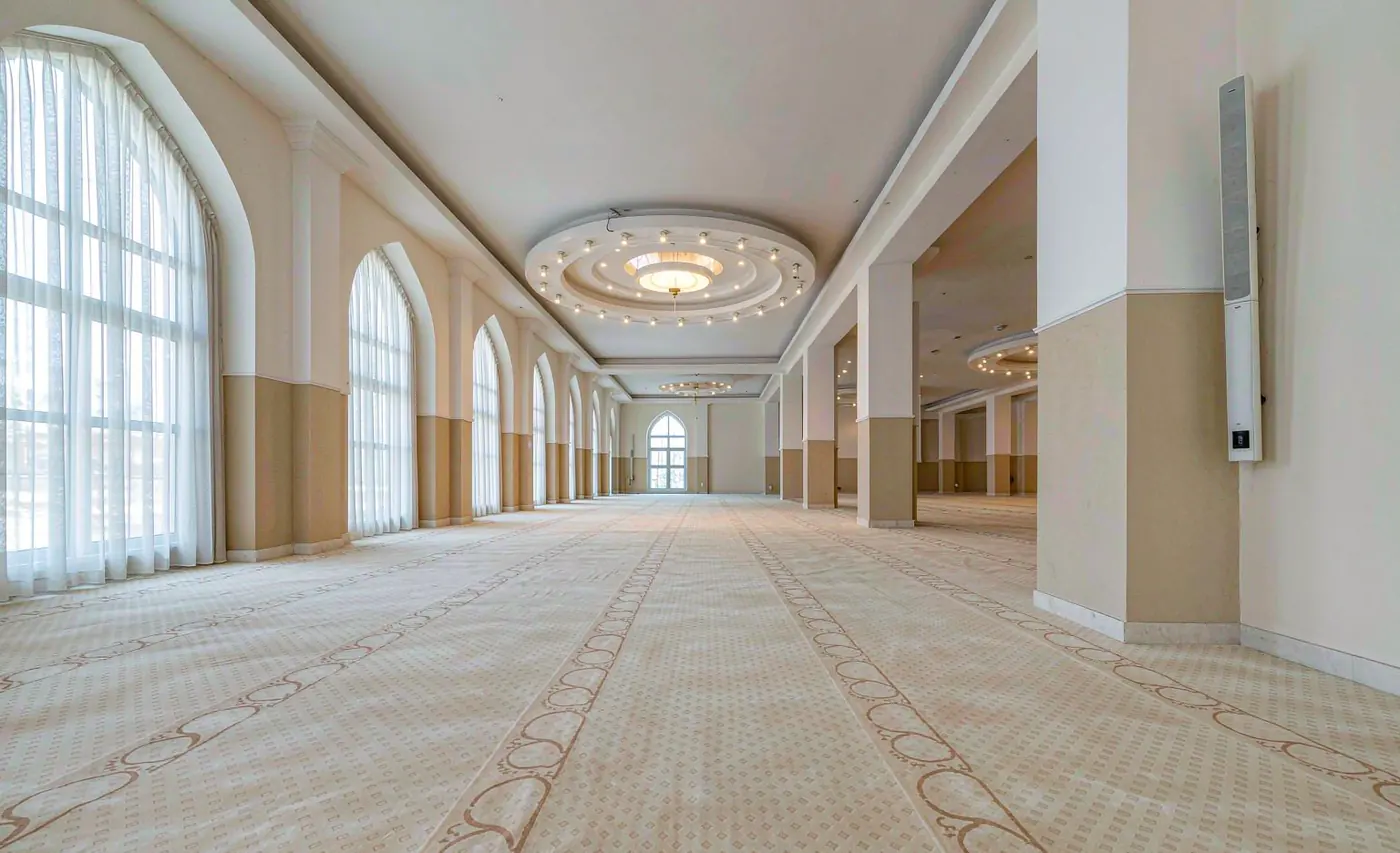
Deep halls, hard surfaces and a single voice to carry. This is how a mosque sound system is designed so the last row hears every consonant — indoors and out.
A mosque is one of the hardest rooms in the world to make speech intelligible. The hall is deep, the surfaces are hard, the floor is carpeted, and the only signal that matters is the human voice — no music, no effects, nothing to mask a fault. If consonants do not arrive cleanly at the back row, the congregation simply stops hearing, and no amount of extra power fixes it.
Three things go wrong in a typical prayer hall, and they compound each other.
The practical conclusion: do not try to fill the hall evenly with a few large loudspeakers. Use narrow vertical dispersion aimed down the length of the room, and keep the direct sound at least 10 dB above the reverberant field in the last rows. That is a geometry problem before it is a power problem.
Manufacturers quote sound pressure at one metre, which tells a buyer nothing. What matters is the level at the listener. Sound falls roughly 6 dB every time the distance doubles, plus air absorption, so a 60 W horn rated 133 dB at 1 m gives approximately:
| Distance from the horn | Typical level | What it means |
|---|---|---|
| 25 m | ≈ 111 dB | Car park and forecourt — clearly audible over traffic |
| 100 m | ≈ 99 dB | Residential streets within the block, still intelligible |
| 200 m | ≈ 93 dB | Outer edge of the call, audible but no longer every word |
| 400 m | ≈ 87 dB | Masked by city noise; needs a second horn position or a taller mount |
Two horns aimed in different directions always beat one horn turned up louder. Turning up a single horn raises the level 3 dB at the listener but doubles the nuisance at the nearest house.
Timing is the part that gets forgotten. The five daily prayers move through the year. A system that can only be re-timed by climbing into a rack room will be re-timed twice and then left alone. Specify a scheduler that accepts a prayer-time table — the EASTVO platform imports a timetable and shifts the Adhan trigger automatically, with a manual override for Jumu'ah and Ramadan.
Two architectures cover almost every project. Choose the network one when the building is new or has structured cabling; choose the 100 V line one when the site already runs a conventional PA and the budget is tight.
| Zone / function | Network (SIP) option | 100 V line option |
|---|---|---|
| Main hall | ES-Y60SO 60 W SIP column, 106 dB — narrow vertical pattern down the length of the hall | EYZ outdoor column series on a zoned amplifier |
| Side walls / rear | ES-S30SO 30 W SIP wall mount, 109 dB | EX series wall speakers, tapped at 6–10 W |
| Courtyard & facade | ES-60SO 60 W SIP horn, 133 dB, IP66 | EQ series horn speakers on a dedicated 100 V run |
| Control position | ES-3001 microphone console + SIP-200 platform | EG series mixer amplifier + EP-119 alarm unit |
| Evacuation (if required) | Alarm API on the same platform | EN-240K6 / EN-500K6 6-zone EVAC controller |
All quoted levels are 1 m figures from the published data sheets. Final device count comes from the room geometry, not from a rule of thumb — send us the plan and we will return a point schedule with mounting heights and tap settings.
Most mosque systems are handed over on "it sounds fine". These five numbers make the handover objective:
| Parameter | Target | How it is measured |
|---|---|---|
| Speech level | 70–75 dB(A) in the last row | Slow, A-weighted, at 1.5 m ear height, with the hall at normal occupancy |
| Signal-to-noise | ≥ 10 dB above ambient in every zone | Ambient measured first, then with programme at operating level |
| Speech intelligibility | STI ≥ 0.50 (0.60 preferred) | STIPA measurement, minimum six positions per zone |
| Reverberation | RT60 ≤ 1.5 s at 500 Hz–2 kHz | Interrupted noise method, unoccupied. Treat the room if it fails — no loudspeaker fixes this. |
| Coverage uniformity | ±3 dB across the seating area | Grid measurement at 1/3 octave, 1 kHz reference |
If the site also needs to evacuate — many larger Islamic centres now do, because they host schools and conferences — the voice alarm function should live on the same platform rather than in a second parallel system. Our EVAC range is built for that combination and the alarm priority stack overrides any Adhan or lesson in progress.
It depends on the volume, not the floor area. As a working rule for a hall up to 6 m ceiling height, one 60 W column speaker covers roughly 8–10 m of hall length per side, mounted 3–4 m up and angled down at about 20 degrees. A 20 x 30 m hall typically needs 4–6 columns, not 2. We size it from the drawing because a domed hall and a flat-ceiling hall of the same area behave completely differently.
Yes, the platform supports scheduled playback from stored audio files as well as live microphone input. Whether a recorded call is acceptable is a local religious and legal question, not a technical one — practice varies between countries and between communities in the same country. What we provide is the capability and a scheduler that can switch between live, recorded and mixed operation.
The scheduler imports an annual prayer-time table and recalculates the trigger automatically, so the Adhan moves with the season without anyone touching the rack. A manual override button sits on the control console for Jumu'ah, Ramadan and the two Eids, when the pattern breaks.
They can, which is why aiming matters more than power. Two horns at moderate level aimed along the street carry further and annoy less than one horn turned up. In dense urban sites we also recommend a night-time level preset that drops the outdoor zone by 6–10 dB for the Fajr call, where local rules allow it.
On a SIP system, each speaker holds its last configuration and the platform keeps an internal schedule, so a switch reboot interrupts audio for a few seconds but does not lose the timetable. For sites where a failure is unacceptable, we specify the 100 V line architecture with a standby amplifier and automatic changeover — the EP-4Z1B does exactly that job.
Yes, and that is the normal design. Classrooms become their own zones with their own sources and schedules, while the hall remains a separate zone. The important part is that the two can never accidentally talk over each other, which is a priority and interlock setting on the controller, not a wiring question.
