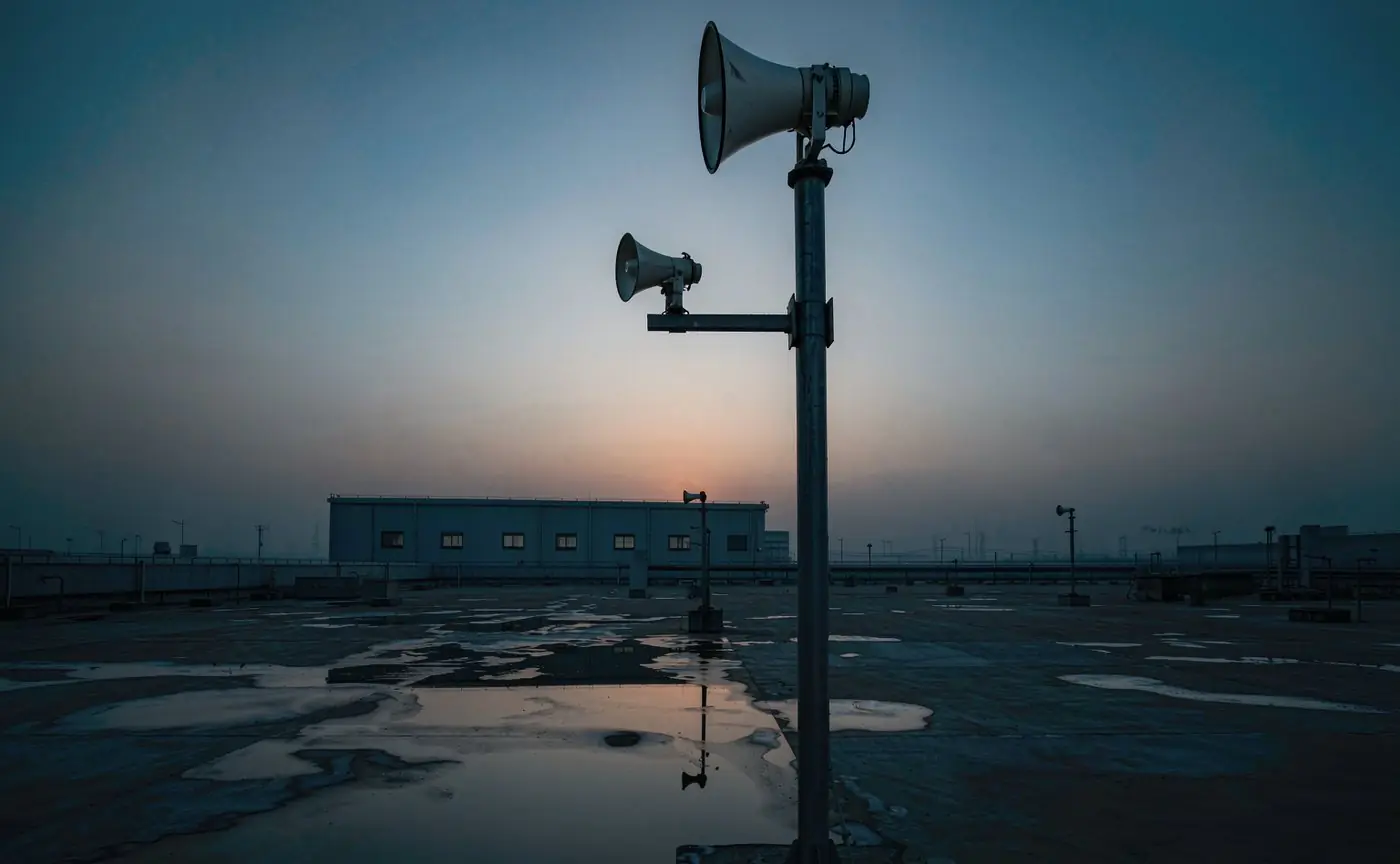
Start with a noise survey, not a speaker list. Ten decibels above the ambient in each area, aimed with a horn instead of shouted with a bigger amplifier.
In a factory the announcement is competing with 85 to 100 dB(A) of machinery, and the person who needs to hear it is wearing hearing protection. This is the one application where more power genuinely is part of the answer — but placement, directivity and the choice of alert tone matter more than the wattage on the data sheet.
Every industrial PA design begins with one number per area: the A-weighted ambient level with production running. Everything else follows from it.
| Area | Typical ambient | Speech level needed | What that implies |
|---|---|---|---|
| Office and control room | 45–55 dB(A) | 65 dB(A) | Ceiling speakers, low power, normal paging design |
| Light assembly | 70–75 dB(A) | 85 dB(A) | Wall or column speakers, 10–15 W taps |
| Heavy production | 85–90 dB(A) | 100 dB(A) | Horns at 6–8 m spacing, aimed at the workstations not down the aisle |
| Compressor / plant room | 95–105 dB(A) | 110+ dB(A) | Horns close to the operator position; speech may be impractical — use tonal alerts |
| Loading bay / yard | 70–80 dB(A) plus weather | 95 dB(A) | IP66 outdoor horns on the building facade |
Where speech cannot win, stop trying. Above roughly 100 dB(A) of broadband machinery noise, no practical loudspeaker makes speech reliably intelligible without exceeding safe exposure limits. The correct specification at that point is a distinctive tonal alert plus a visual beacon, with the spoken message delivered where the noise is lower. Saying so in the design document is what separates a working system from a warranty argument.
In a reverberant shed, sound that is not aimed at a listener becomes noise that masks the next announcement. Horn speakers are used here for one reason: a horn puts energy into a cone of roughly 60 x 40 degrees, which keeps it off the steel roof and off the neighbouring line.
| Function | Recommended | Why |
|---|---|---|
| Indoor heavy production | EQ series horn speakers | High sensitivity, controlled dispersion, 100 V taps for line loss management |
| Outdoor yard, loading bay | ES-60SO 60 W SIP horn, 133 dB, IP66 | Network-powered, no separate amplifier at the far end of the yard |
| Long aisles, warehouses | ES-Y60SO SIP column speaker | Narrow vertical pattern follows the racking instead of crossing it |
| Amplification | EG series mixer amplifiers with EP-16L sequencer | Zone-per-amplifier architecture; sequenced power-up avoids inrush tripping |
| Evacuation | EN-240K6 / EN-500K6 | Dedicated 6-zone EVAC controller with monitored lines and battery backup |
Industrial sites destroy equipment that was specified for an office. The three failure modes we see most:
For genuinely explosive atmospheres — solvent stores, flour mills, some paint lines — a standard IP66 horn is not acceptable. Intrinsically safe or flameproof loudspeakers are a separate certified product category, and we will say so rather than supply something that looks compliant.
Ten decibels above the ambient noise in that specific area. If the line runs at 88 dB(A), the announcement needs roughly 98 dB(A) at the workstation — not at the speaker. A single plant-wide level always either deafens the office or disappears in the heavy bay, which is why zoning by noise level rather than by building is the first design decision.
It can be done on a network platform with a priority stack and an alarm interface, and many sites do exactly that. Where local code requires a certified voice alarm, the evacuation function must be carried by a product that holds the certificate — for us that is the EN series controller, which can sit alongside the paging system or replace its emergency function entirely.
IP66 for anything in a production hall with dust, moisture or washdown, even though it is technically indoors. IP54 and below is for offices and clean assembly only. Dust is the single most common cause of premature failure we see in industrial installations.
Use a distinctive tonal alert plus a visual beacon, and move the spoken message to an adjacent lower-noise area or to supervisors' radios. Trying to shout over 100 dB(A) of machinery produces exposure levels that breach hearing protection limits and still does not deliver intelligible speech.
Yes. Either a fixed paging microphone at the line supervisor's station, or a SIP handset that registers to the same platform and can address its own zone. The second option is usually cheaper to cable in an existing plant and gives the supervisor a normal telephone interface.
Standard IP66 loudspeakers are not certified for explosive atmospheres. Solvent stores, flour and sugar handling, and some paint lines need flameproof or intrinsically safe equipment with its own certification. We will flag this during design rather than let a standard horn be installed where it does not belong.
